What Positioning Actually Is
Positioning is not your tagline. It is not your brand. It is not how you describe your product on your website. Positioning is the architecture of context — the deliberate act of defining how your product is a leader at delivering something a well-defined set of customers cares deeply about.
When a potential buyer encounters your product for the first time, they do something automatic: they try to place it in a mental box based on what they already know. "This looks like a SIEM." "This reminds me of Datadog." "I think this is some kind of compliance tool." That box determines everything — what they expect you to cost, who they compare you to, and what questions they ask on a first call.
If you don't choose that box deliberately, the buyer picks one for you. And the box they pick will almost always highlight your weaknesses rather than your strengths. A runtime security product gets compared to legacy SIEMs. A developer-first compliance tool gets lumped with enterprise GRC platforms. The feature set is the same either way — but the context changes what the buyer sees.
Research shows buyers don't evaluate every option rationally. They satisfice — choosing from the three to five brands they already have in mind for a given job. If your product isn't in that mental shortlist, it doesn't matter how good it is. You're not even in the running. Positioning is how you get into that shortlist — or better yet, how you create a new one where you're the default.
Think of positioning as the opening scene of a movie. Before the plot can unfold — before pricing, features, and competitive comparisons mean anything — the audience needs to understand the setting, the stakes, and the characters. Positioning sets up that scene. Get it right, and everything else lands. Get it wrong, and even brilliant features fall flat because the buyer lacks the context to appreciate them.
Positioning Is Not Messaging Is Not Copy
One reason founders get stuck is that they conflate four distinct layers of go-to-market communication. Each layer has a different job. Skipping one guarantees the layers below it break.
The big story about how the world is changing and why your company exists. It's the 10,000-foot view — the shift in the market that creates the need for a new category or approach.
"Legacy security was built for static infrastructure. The cloud broke that model."
Your specific place in the market. Who you're for, what you replace, what makes you different, and why it matters. This is the strategic frame that everything downstream depends on.
"We are the runtime security layer for cloud-native teams who need threat detection that works in production, not just in theory."
The articulation of your positioning in language that resonates with specific audiences. Different personas may need different messaging — but all of it flows from the same positioning.
For CISOs: "Stop runtime threats before they become breaches." For DevOps: "Security that deploys in minutes, not months."
The final execution: headlines, email subject lines, ad text, landing page copy. This is what most founders jump to first — and exactly why it fails. Copy without positioning underneath is just words.
A homepage headline, a LinkedIn ad, an outbound email subject line.
Most companies hire a copywriter when what they actually need is a positioning decision. The copy feels wrong not because the writer is bad, but because there's no strategic foundation for the writer to build on. Fix the positioning, and the copy almost writes itself.
Why Founders Get It Wrong
Founders are usually the worst people at positioning their own product. Not because they lack intelligence — the opposite. They understand their technology so deeply that they cannot see it through a buyer's eyes. Four patterns show up repeatedly:
The "platform" trap. Your product does one thing exceptionally well — say, runtime threat detection. But calling it a "platform" feels bigger, more fundable, more impressive. So you position as a "comprehensive cloud security platform" and immediately vanish into a category with 50 other companies saying the same thing. The buyer cannot tell what makes you different because you have deliberately obscured it.
Feature obsession. You lead with what you built instead of what the buyer struggles with. "AI-powered threat detection with real-time correlation across multi-cloud environments." That describes your engineering. It says nothing about why a CISO should care right now. We scored 300+ cybersecurity homepages and found that the most common claims — AI-powered, unified platform, visibility — all describe the vendor's technology, not the buyer's problem.
Trying to serve everyone. You refuse to pick a niche because the TAM looks bigger if you target everyone. The result: messaging so generic it resonates with no one. "Cloud security for modern enterprises" could belong to any of your competitors. Swap the logo and nothing changes. The counterintuitive truth is that the narrower your target, the faster you grow — because specificity creates relevance, and relevance creates pipeline. This matters even more when you consider that roughly 95% of your category's buyers aren't actively looking right now. The 5% who are will choose from the brands they already know. If your broad messaging hasn't planted you in their memory, you've lost before the evaluation begins.
Inward-facing messaging. Your homepage talks about you, not your customer. "We provide..." "Our solution..." "Our technology enables..." Every sentence starts with your company name. The buyer lands on your site and hears a monologue about your product. What they wanted to hear was: "You have a problem. We understand it. Here's how it gets solved." When the homepage leads with features instead of problems, it consistently scores 0–2 on Buyer vs Product Focus — the most diagnostic dimension in our scoring model.
The Symptoms of Broken Positioning
Positioning problems rarely announce themselves as positioning problems. They show up as symptoms elsewhere in the GTM — and founders often misdiagnose the cause. Here's what broken positioning actually looks like in the business:
- Your website gets traffic but generates no inbound. People visit, scan the homepage, can't figure out if this is for them, and leave. It is not a design problem. It is a clarity problem.
- Outbound reply rates are below 3%. SDRs are sending hundreds of emails a week that describe what the product does, not why the recipient should care right now. The emails sound like every other vendor email in the inbox.
- First calls don't convert. The prospect took the meeting, but 20 minutes into the demo they are already mentally checked out. The conversation started with features instead of diagnosis. The buyer never felt understood.
- Marketing and sales tell different stories. The website promises "unified visibility." The sales deck opens with "risk prioritization." The outbound sequence leads with "compliance automation." The buyer feels the incoherence even if they can't name it.
- Sales cycles drag on with "let me think about it." The buyer doesn't say no. They just never say yes. The problem: you haven't given them a clear frame for evaluating the decision. Without positioning, there's no urgency and no context for comparison.
- Analysts and customers describe you differently than you do. You say "CNAPP." Your customers say "the tool we use for runtime alerts." Gartner puts you in a quadrant you didn't expect. When the market's perception doesn't match your intention, positioning is the gap.
If three or more of these feel familiar, the issue is almost certainly positioning — not your product, not your sales team, not your marketing budget.
What Good Positioning Looks Like
Before we get to the framework, it helps to see what strong positioning actually looks like in the wild. These companies get it right — and the reasons are instructive.
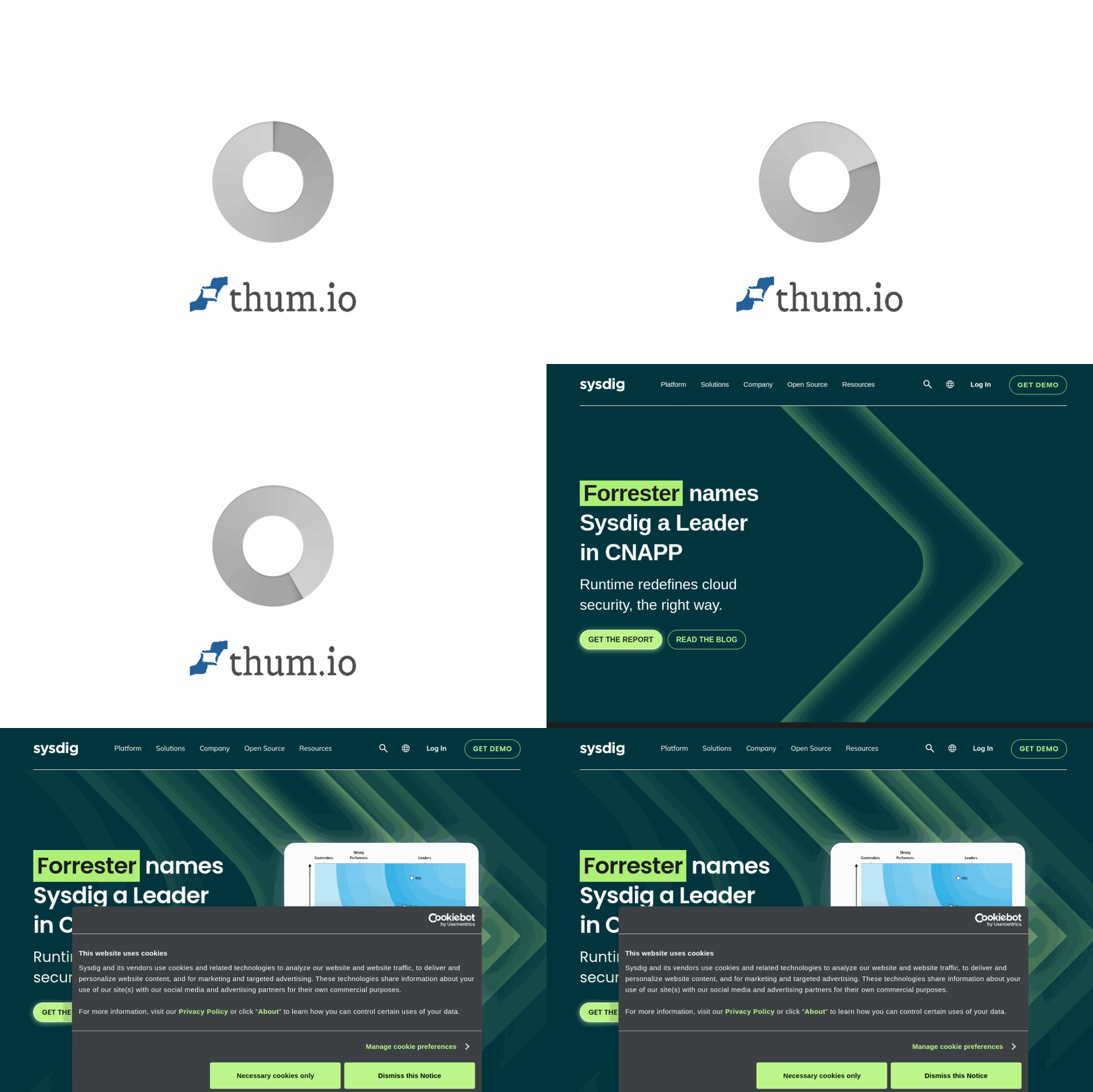
"Cloud Security Starts at Runtime." In a category where every competitor leads with "comprehensive cloud security platform," Sysdig makes a contrarian claim that reframes the entire market. They don't just describe what they do — they argue that the rest of the industry has the order wrong.
This is textbook positioning. It picks a fight with the status quo (shift-left-only approaches), names a specific differentiator (runtime), and implies that if you're not starting there, you're starting in the wrong place. A CISO who believes runtime matters immediately self-selects.
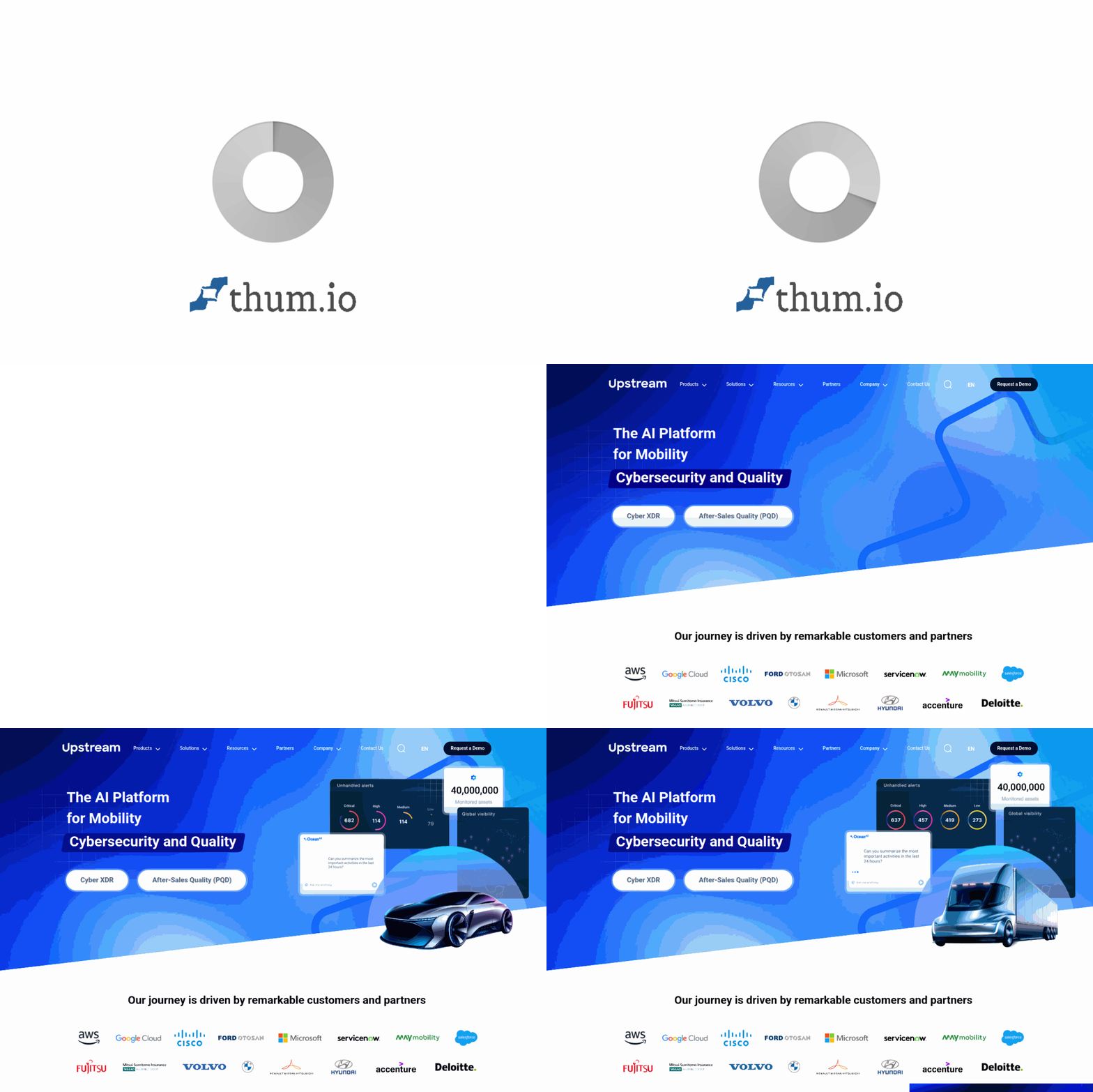
"The AI Platform for Mobility Cybersecurity." Upstream doesn't try to be a general cloud security company. They own a vertical: connected vehicles and smart mobility. The moment you read the headline, you know exactly who this is for and who it isn't.
This is the power of niche positioning. The total addressable market looks smaller on a spreadsheet, but the conversion rate is dramatically higher. An automotive CISO lands on this page and thinks: "This is built for me." No generic cloud security vendor can create that reaction.
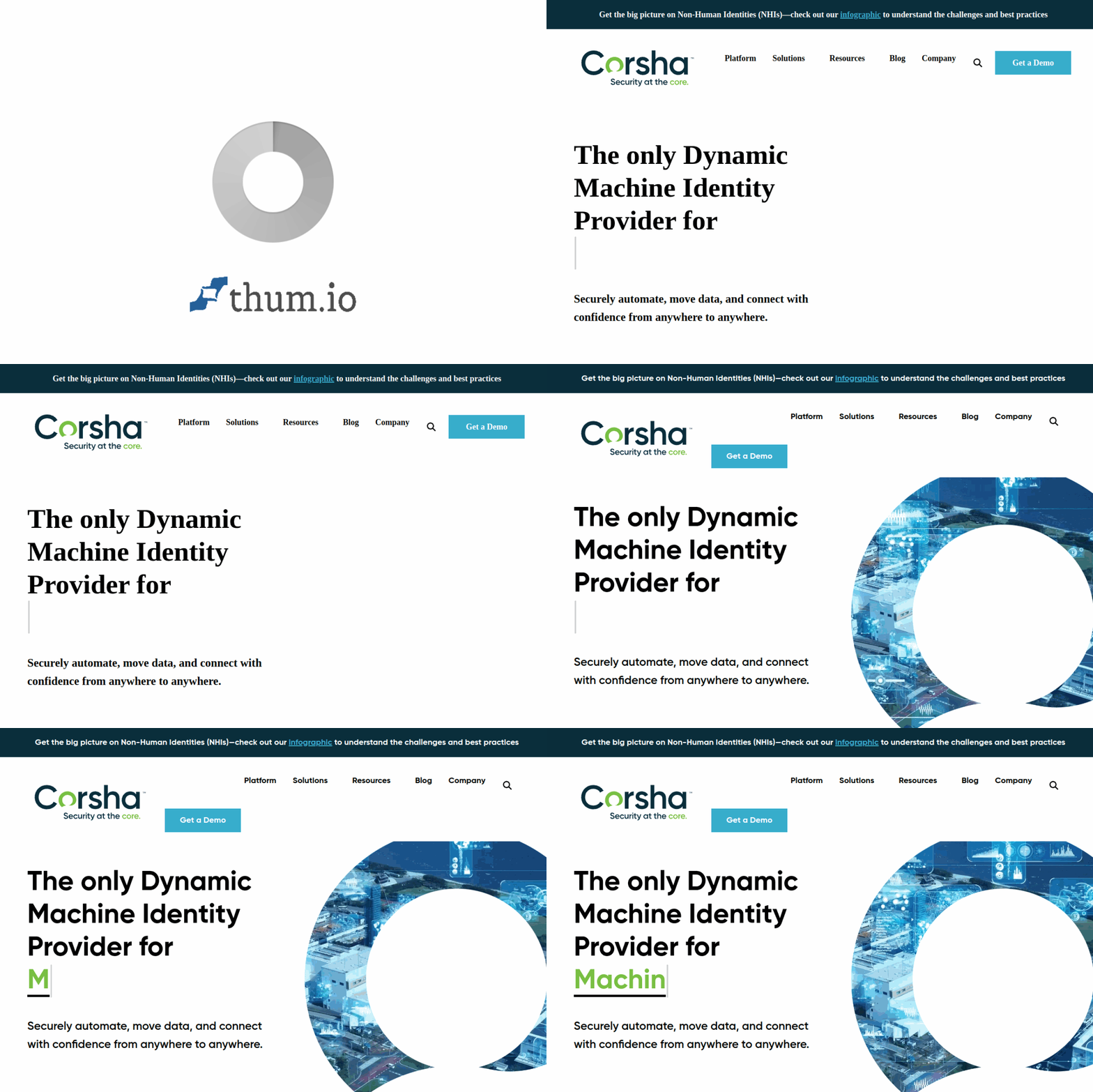
"The only Dynamic Machine Identity Provider." Three words do all the work: "the only." Corsha doesn't claim to be better. They claim to be the only company doing this specific thing. That's the strongest form of differentiation — a category of one.
Notice the specificity: not "identity management" (crowded), not "API security" (generic), but "Dynamic Machine Identity" — a new subcategory they define and own. When you create the category, you are the default leader.
The pattern across all three: specificity beats generality. Each company made a deliberate choice about what to emphasize and — just as importantly — what to leave out. That's positioning.
Choosing Your Positioning Type
Not all positioning works the same way. The right approach depends on your competitive landscape, your product's maturity, and how much market education you're willing to invest in. Here are seven positioning types, ordered from lowest risk to highest — each with real trade-offs.
Category Niche Low Risk
Claim a specific slice of an existing category and own it completely. This is the most common winning pattern in cybersecurity. Instead of fighting the category leader on their terms, you take the one corner they can't serve well and make it yours.
Use-Case Specific Low Risk
Frame the same product around a single high-urgency workflow that buyers already have budget for. You're not changing what the product does — you're changing which problem the buyer sees it solving. Works especially well when the use case maps to a line item in existing security budgets.
Head-to-Head Moderate Risk
Position directly against the category leader on a dimension buyers care about but the leader underdelivers on. This only works if your advantage is genuine and demonstrable — not aspirational. The upside: instant context. The downside: the leader defines the rules of the game, and you're playing on their field.
Vertical-Specific Moderate Risk
Position for a specific industry where you have deep domain expertise. Powerful because it signals "built for us" rather than "adapted for us." In cyber, this works when the industry has unique compliance requirements, threat models, or technology stacks that horizontal vendors can't credibly address.
Persona-Specific Moderate Risk
Frame the product around who uses it rather than what it does. Works when a specific buyer persona is underserved by incumbents — when the tools exist but weren't built for them. The risk is that persona-specific positioning can limit deal size if the persona doesn't hold budget.
The "Only" Claim Bold
Position around a capability no one else credibly offers. Requires a genuinely unique technical approach — not marketing spin. When it's real, it's the strongest form of differentiation: instead of being better, you're the only one doing this specific thing. That eliminates comparison and collapses the competitive evaluation.
Market Creation Bold
Define an entirely new category. Highest risk, highest ceiling. This only works with significant funding, market timing, and the patience to educate buyers on a problem they don't know they have yet. Most companies that attempt this would have been better served by a category niche strategy.
A pattern from analyzing over 200 cybersecurity companies: the highest-scoring websites almost always use Category Niche, Vertical-Specific, or "The Only" Claim. Head-to-Head works when you genuinely outperform the incumbent. Market Creation works when you have the runway. But for most Series A–B companies, specificity is the fastest path to traction.
A Framework for Getting Positioning Right
Positioning is not a creative exercise. It's a structured process. We've developed a framework built on five core questions — each one building on the last. Answer them in order, and you'll have a positioning foundation that's rooted in evidence, not assumptions.
Who are your happiest customers?
Start from evidence, not aspiration. Look at who bought fastest, advocated loudest, renewed without negotiation. These customers reveal your product's true value — not the value you designed for, but the value the market actually experiences.
For early-stage companies, this might be just 3–5 accounts. That's enough. What matters is that you study them closely: what triggered the purchase? What did they try before? What would they do without you?
List your 5 happiest customers. For each one, write down: how they found you, how long the sales cycle was, and what they say when they recommend you to a peer. Look for patterns.
What would they do without you?
Your real competitive alternative is not always a direct competitor. It's whatever the customer would do if your product didn't exist. Often, that's a spreadsheet. A manual process. Stitching together three open-source tools. Or simply doing nothing and accepting the risk.
This matters because your value is relative to the alternative. If a CISO's alternative is manually triaging 500 alerts a day, your value proposition is about time and accuracy. If their alternative is a competing product, your value proposition is about differentiation.
Ask your last 3 customers: "What were you doing to solve this before you found us?" The answer is your real competitive alternative — and it may surprise you.
What can you do that the alternatives can't?
Now list the specific capabilities — features, technical architecture, domain expertise — that your product has and the alternatives do not. Be precise. "Better AI" is not a capability. "Runtime behavioral analysis that detects lateral movement within 30 seconds" is.
These are your unique attributes. They are facts, not opinions. If a competitor can make the same claim, cross it off the list.
Write down every feature or capability your product has. Cross out anything a competitor also offers. What's left? Those are your actual differentiators.
So what?
Each unique capability must translate into value the buyer actually cares about. "We do X" is not positioning. "Which means you get Y" is.
A capability like "agentless deployment" becomes a value theme: "Your team gets full visibility in 10 minutes, not 10 weeks — with zero infrastructure changes." The feature is the input. The value theme is the output. Buyers pay for outcomes, not architecture.
For each differentiator you listed above, complete this sentence: "We do [capability], which means the customer gets [specific outcome]." If you can't name a specific outcome, the capability may not matter as much as you think.
Who cares the most?
Not everyone values your unique capabilities equally. The final step defines the specific segment for whom this value is not a nice-to-have but a top priority — the segment that buys fastest and advocates loudest.
Go beyond demographics. A useful segment isn't "mid-market companies." It's "Series A infrastructure companies with 5–50 cloud accounts, no dedicated security team, and an upcoming SOC 2 audit." That precision is what makes outbound work at 8% reply rates instead of 1%.
Describe your ideal buyer using situational triggers, not demographics. What event just happened in their business that makes your value proposition urgent? A funding round? A compliance deadline? A security incident? That's your targeting angle.
The 7 Dimensions of Strong Positioning
Once you've built a positioning foundation with the framework above, you need a way to evaluate whether it's actually working — on your website, in your sales conversations, across every touchpoint. We score positioning across seven dimensions. Use them as a self-audit.
Market Category Clarity
Can a visitor instantly understand what your company does and what category it belongs to?
Litmus test: Show your homepage to someone outside your industry for 5 seconds. Can they tell you what you do?
Value Differentiation
Does your messaging articulate value that only your company delivers? Or could you swap your logo with a competitor's and the copy still works?
Litmus test: Replace your company name with a competitor's on your homepage. If nothing feels wrong, you have a differentiation problem.
Customer-Problem Orientation
Does your homepage lead with the buyer's pain or your product's capabilities? Feature-first homepages cap at 4/10 on this dimension regardless of how good the product is.
Litmus test: Count how many times your homepage says "we" or "our" versus "you" or "your." The ratio tells you whose story you're telling.
Specificity & Evidence
Are your claims backed by numbers, named customers, and proof — or are they abstract assertions anyone could make?
Litmus test: Count the proof points on your homepage. If you find zero numbers and zero named customers, your messaging is pure assertion.
Audience Targeting Precision
Does your site speak to a clearly defined buyer, or does it try to be everything to everyone?
Litmus test: Can a visitor tell within 10 seconds whether this product is for them specifically — or do they have to guess?
Competitive Context
Does your site acknowledge what you replace and why you're the better choice? Or does it exist in a vacuum, as if no alternatives exist?
Litmus test: Does your homepage or product page mention what the buyer currently does today (the status quo) and why that's insufficient?
Conversion Architecture
Do your CTAs, navigation, and page structure guide a clear buyer journey? Or is "Book a Demo" the only action available?
Litmus test: Does your primary CTA reflect your unique value — or is it a generic "Book a Demo" that every competitor also uses?
Want to see where your positioning breaks down?
We score your homepage across all 7 dimensions and show you exactly what to fix.
Get Your Free AuditPositioning Is Not a Tagline
Even founders who recognize the importance of positioning often misunderstand what it actually involves. Four misconceptions get in the way:
"We just need better copy." Messaging is the output of positioning, not a substitute for it. You can hire the best copywriter in the world, but if the underlying positioning is wrong — if you haven't decided who you're for, what you replace, and why you're different — the copy will be beautifully written and strategically meaningless. Fix the positioning first. The words follow.
"Our product sells itself." No product sells itself. Not one. Even technically superior products lose to inferior competitors with better positioning every day. The buyer doesn't evaluate your product in a vacuum. They evaluate it relative to alternatives, within a category, against expectations you either set or left to chance. The product is the answer. Positioning is the question that makes the answer relevant.
"We can target everyone later." You can't. Trying to be everything to everyone is how you end up being nothing to anyone. Broad targeting produces broad messaging produces low reply rates produces wasted budget. The companies that grow fastest are the ones that chose a narrow segment, dominated it, and expanded from a position of strength. You don't lose market by niching down. You gain relevance.
"We already did positioning." If nobody on your team can state your positioning in one sentence that sounds different from every competitor in your category, you haven't done positioning. You've done a brainstorm. Real positioning produces a clear, evidence-based articulation of who you're for, what you replace, why you're different, and why it matters now. If that doesn't exist in a form everyone can use, the work isn't done.